Southwest Pacific Area
Office of the Commanding General
June 20, 1944
Dear Mrs. Bertram:
Recently your son, Lieutenant Martin Bertram, was decorated with the Air
Medal. It was an award
made in recognition of courageous service to his combat organization, his
fellow American
Airmen, his country, his home, and to you. He was cited for meritorious
achievement while
participating in an arial fight northwest of New Hanover Island.
Your son was a pilot of an aircraft in a formation engaged in an attack
against an enemy
convoy. His plane made a bombing run on a large freighter, setting
the vessel on fire by strafing
and plunging two 500 pound bombs against it's bow. As the plane passed
over the ship,
an anti-aircraft shell burst into the bomb bay, completely destroying the
hydraulic system. The
crew nevertheless made another run and scored two near misses, leaving
the vessel enveloped
in flames and sinking fast.
Almost every hour of every day your son, and the sons of other American
mothers, are doing
just such things as that here in the Southwest Pacific. Theirs is
a very real and very tangible
contribution to victory and to peace.
I would like to tell you how genuinely proud I am to have men such as your
son in my command, and
how gratified I am to know that young Americans with such courage and resourcefulness
are
fighting our country's battle against the aggressor nations.
You, Mrs. Bertram, have every reason to share that pride and gratification.
Very Sincerely,
GEORGE C. KENNEY
Lieutenant General
Commanding.

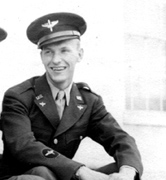
1st Lieutenant Martin Bertram served
as a pilot in USAAF fighters and bombers in the 5th
Air Force under General George Kenney, based first in Australia, then later
in New Guinea.
he planes he flew on his 47 combat missions included the P-41 Tomahawk,
A-20 attack
bomber, P-38 Lightning Twin Engine Fighter, and the B-25 Mitchell medium
bomber. The
missions he flew were primarily tactical air to sea and air to land missions,
strafing and bombing
Japanese airfields, bases, and ships.
He was shot down twice by ship based anti-aircraft fire. After his
second downing, he was not
permitted back into combat because of the seriousness of his wounds but
continued to serve as a
pilot testing repaired aircraft in the rear areas and as an Air Staff Liaison
officer.
He was awarded the Purple Heart twice, the air Medal 3 times, and the Bronze
Star 3 times
for actions over New Guinea, Northern Soloman Islands, and campaign of
the Bismarck Archipelago.
He was also awarded The Distinguished Flying Cross, The Southern Philippines
Battle star, The Philippine
Liberation Ribbon with one Bronze Star, The American Theater Ribbon, a
Presidential Unit Citation, and
the Asiatic Pacific Ribbon.
Promoted to captain sometime in the confusion of war, he never received
his orders and never
wore the rank of captain. He was offered the opportunity to serve
in the Korean Conflict
as a Major, but declined.